What the VITA Shade Guide Actually Measures
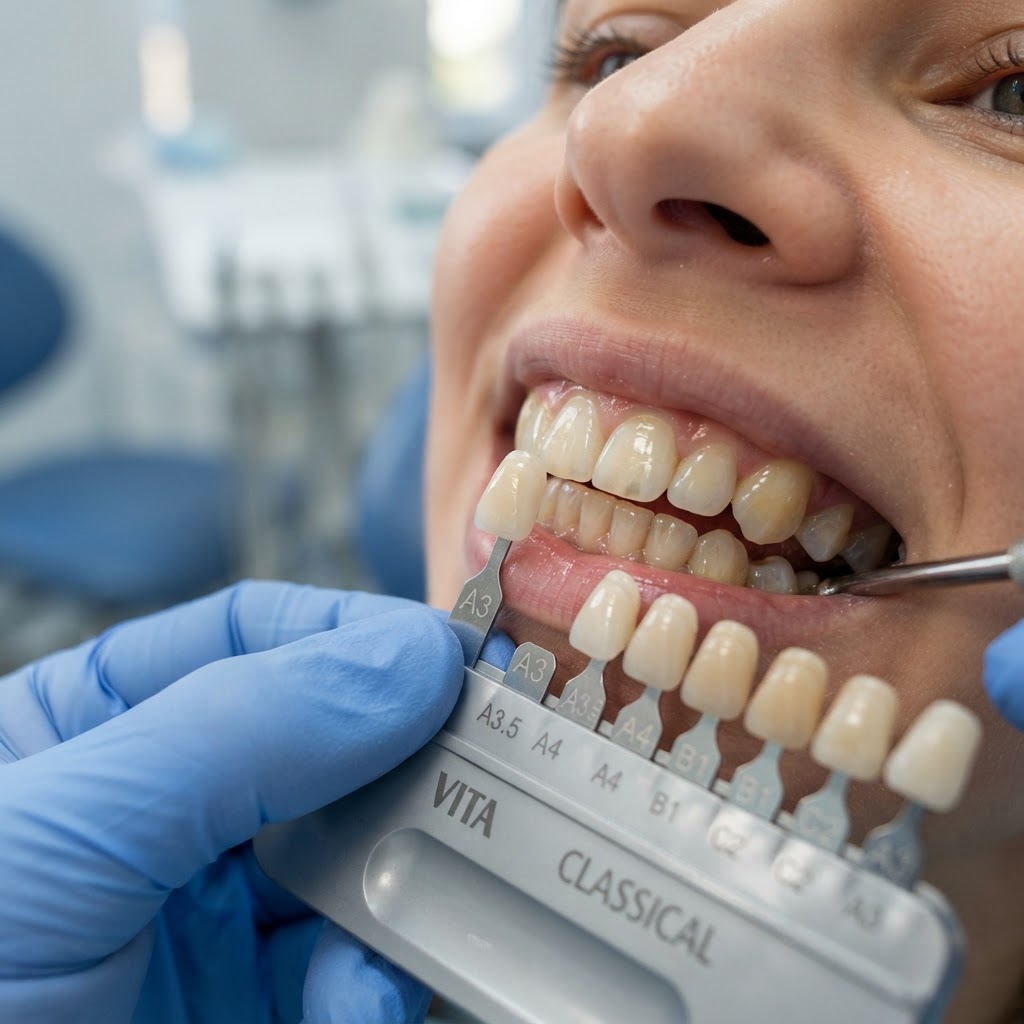
The VITA Classical scale is the global language of tooth color. Here is what those A1–C4 codes really mean — and why your dentist uses them.
The VITA Classical shade guide is the most widely used tooth-color reference in dentistry. It arranges 16 shades into four hue families — A (reddish-brown), B (reddish-yellow), C (grey) and D (reddish-grey) — each with increasing value (lightness) and decreasing chroma (saturation) as the number rises. A1 is lighter and less saturated than A4; C4 is the darkest, most saturated grey-brown.
| Shade | Family | L* | a* | b* | Hex |
|---|---|---|---|---|---|
| A1 | A · reddish-brown | 79.0 | 3.3 | 16.5 | #FBFAF5 |
| A2 | A · reddish-brown | 73.0 | 5.5 | 19.8 | #E9DCC5 |
| A3 | A · reddish-brown | 68.0 | 8.5 | 22.0 | #E2D3B9 |
| A3.5 | A · reddish-brown | 65.5 | 10.0 | 23.0 | #E0CCA9 |
| A4 | A · reddish-brown | 62.0 | 12.0 | 24.0 | #C9A978 |
| B1 | B · reddish-yellow | 75.0 | 2.5 | 13.0 | #F4EEE0 |
| B2 | B · reddish-yellow | 70.0 | 4.0 | 17.0 | #E3D3B7 |
| B3 | B · reddish-yellow | 66.0 | 5.5 | 19.0 | #DEC69F |
| B4 | B · reddish-yellow | 63.0 | 7.0 | 21.0 | #D8C291 |
| C1 | C · grey | 73.0 | 2.5 | 12.0 | #C4C1BC |
| C2 | C · grey | 68.0 | 4.0 | 15.0 | #BAB7B1 |
| C3 | C · grey | 64.0 | 5.0 | 17.0 | #A4A29D |
| C4 | C · grey | 60.0 | 6.0 | 19.0 | #8B8A87 |
| D2 | D · reddish-grey | 76.0 | 3.0 | 14.0 | #B29D99 |
| D3 | D · reddish-grey | 70.0 | 4.5 | 16.0 | #A48C89 |
| D4 | D · reddish-grey | 66.0 | 6.0 | 18.0 | #978480 |
L*, a*, b* are representative spectrophotometric means (O’Brien et al., 1997; normalized). Hex sampled from teewai’s calibrated VITA reference card.
Dentists use VITA because human color perception is unreliable under different lighting. A tooth that looks "yellow" under a warm bulb can look "grey" under cool daylight. The guide gives a fixed, calibrated reference so two clinicians can describe the same tooth with the same code — and so whitening progress can be measured objectively instead of by eye.
teewai maps your scan to the VITA scale by analyzing the L*, a*, b* color coordinates of your enamel — the same CIE Lab space used in dental spectrophotometry research. The result is a shade code you can take to any dentist and they will recognize it.
The Bleachedguide (0M1–0M3)
A second, newer VITA scale covers shades only reachable through professional whitening. When teewai detects one, it flags that you have undergone artificial whitening so your journey is interpreted correctly — not scored against natural-tooth baselines.
One nuance worth knowing: natural teeth are not pure white. Healthy, unstained adult enamel typically lands around A2–A3 on the VITA scale — a faint, warm ivory. That is your baseline, not a failure. Whitening shifts you lighter within the scale, but the goal is a natural brightness, not a chalk-white that no real tooth achieves.
See where you sit on the VITA scale — scan your smile with teewai.